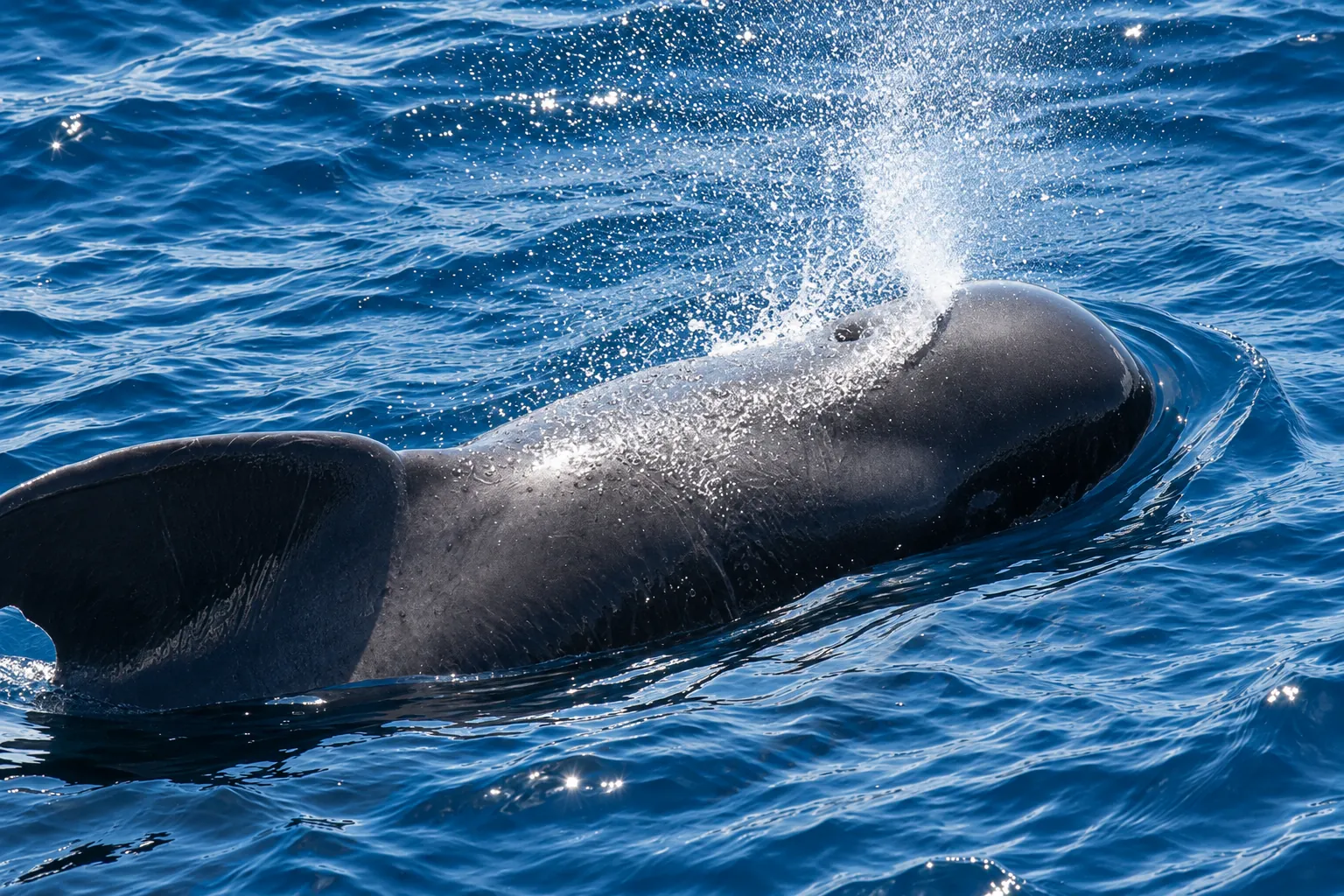
Short-finned pilot whale swimming at the surface

Cetaceans

Our neighbours on the south-west coast

Tenerife is one of the best places in the world to see whales and dolphins in their own environment. Short-finned pilot whales and bottlenose dolphins live here all year round.

Another 21 species of whales and dolphins pass along the south coast on their migration, including the blue whale and the orca. You can also see seabirds such as the yellow-legged gull and the shearwater and, at certain times of year, loggerhead and green turtles.

Pilot whales and bottlenose dolphins have settled here: there is food, calm and clear water and good weather all year.

Resident

Short-finned pilot whale

Globicephala macrorhynchus

A member of the oceanic dolphin family. Almost black, with a rounded head and a broad dorsal fin set well forward and curved back. It is the one seen most often on our trips: very sociable, with strong family bonds.

Adult males exceed 5 m
Between 1 and 2 tonnes

Did you know…? “Globicephala” means globe-shaped head.

Resident

Bottlenose dolphin

Tursiops truncatus

A resident: it can be found close to the coast all year round. Large and sturdy, dark grey on the back and lighter towards the belly. They live in groups of 10 to 30.

Males average about 2.7 m
They live for over 30 years
All year round

Common dolphin

Delphinus delphis

It can be seen all year, especially in winter. Active and playful: it loves riding the bow wave of boats and jumping.

Up to 2.5 m
80 to 130 kg

Did you know…? It can swim at almost 45 km/h.

Passing through

Sperm whale

Physeter macrocephalus

The largest toothed cetacean. A huge head, dark wrinkled skin and a small hump instead of a dorsal fin. It dives to about 2,000 m to hunt giant squid.

11 to 18 m
15 to 60 tonnes

Did you know…? It can have up to 50 teeth.

How to watch a cetacean

Always

  • Keep at least 60 metres away.
  • Watch for 30 minutes at most.
  • Sail slowly.
  • Avoid gathering many boats together.
  • Leave if the animals are disturbed.

Never

  • Swim with them.
  • Feed them.
  • Touch them.
  • Throw anything into the sea.
  • Make noises that disturb them.

The company holds all the licences for this activity and the Spanish Government permit for whale watching. Its boats fly the yellow flag that identifies authorised vessels.

Come and see them